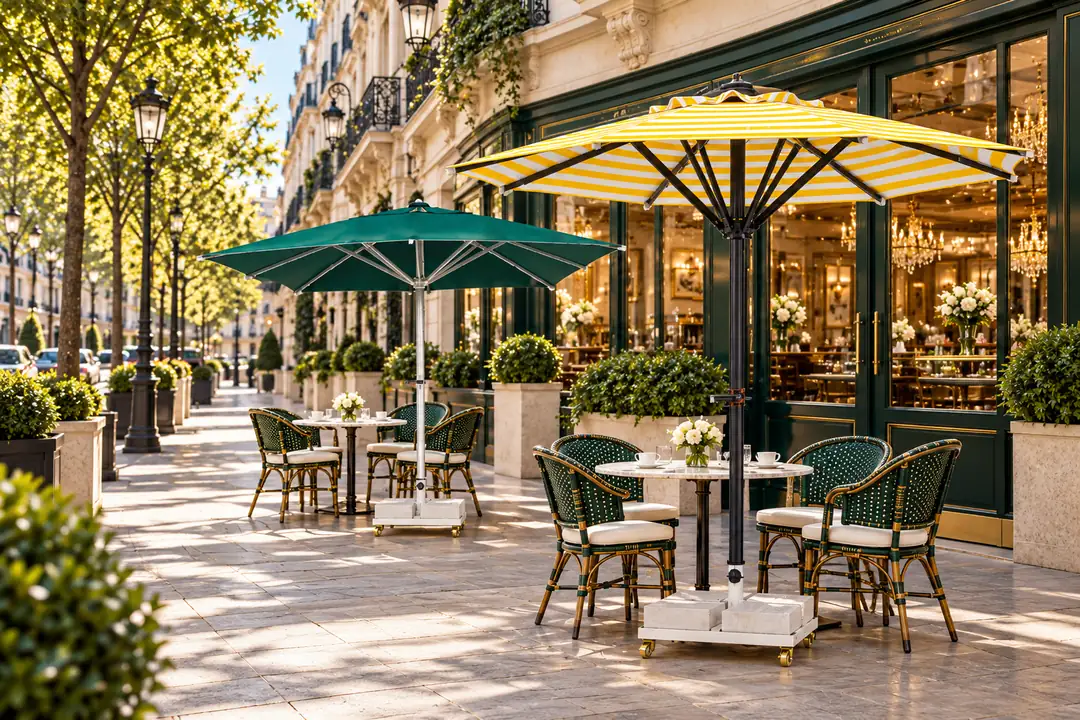
Outdoor layout for a restaurant or cafe business is a critical element that directly affects the guest experience. Outdoor seating areas, especially in good weather, offer businesses the potential to increase their capacity and attract more customers. One of the most basic ways to make these areas comfortable and functional is suitable shading solutions.
A quality parasol is indispensable for protection from the scorching sun or light rain. However, parasols designed for commercial use have different features than home-type products. These differences are important factors that directly affect parasol prices as well.
Restaurant and cafe parasols stand out with their durability, sizes, mechanisms and designs. Choosing a parasol that will suit your business's aesthetics and perform for many years is an investment decision that goes beyond the initial cost. In this article, we will cover all the details you should consider when choosing the right parasol for your business.
The different parasol types, material qualities and additional features on the market lead to large variations in price ranges. With proper research and an informed choice, you can find the parasol solution that best fits your budget and meets your business's needs. Remember that a quality parasol not only provides shade but also adds value to your business's outdoor space and increases customer satisfaction.
When buying a parasol, instead of focusing only on the initial price, it is important to also evaluate the product's longevity, ease of maintenance and warranty terms. This way, you make a more economical and efficient investment in the long run. Never underestimate the importance of parasols in making your business's outdoor area attractive.
Key Factors Affecting the Choice of Sunshade for Commercial Businesses
For commercial businesses such as restaurants and cafes, choosing the right shading solution is not just an aesthetic preference but also an operational necessity. Choosing the right parasol both increases customer comfort and directly contributes to the business's profitability. There are many factors affecting this choice, and each plays an important role in pricing.
Material quality is decisive for the parasol's durability and therefore its life. Heavy-duty aluminum or steel frames are more resistant to wind and heavy use. Fabric quality also determines its resistance to UV rays, water and fading. Although such features raise the initial cost, they save money in the long run by eliminating the need for frequent replacement.
The parasol's size and shape should be determined according to the size and layout of the area to be shaded. Parasols that will cover large and wide areas will naturally cost more. Different shapes such as square, rectangular or round are important to fit the architecture and furniture layout of the available space.
The opening and closing mechanism is also critical for ease of use. Telescopic or crank-handle mechanisms offer practical solutions for staff. Some advanced models may also have remote-controlled or automatic opening/closing systems, which is a feature that raises the price. The way the parasol is fixed is also important; models fixed to the ground are generally safer and sturdier.
Additional features and design elements also affect the cost. Customizations such as LED lighting, heater integration or logo printing increase the parasol's functionality and brand awareness while also pushing the price up. Special designs that offer an aesthetic look can also be more expensive than standard models.
Supplier choice is another important point. A reliable supplier offers assurance not only in quality products but also in matters such as after-sales support, spare part supply and warranty. When all these elements come together, you can find the most suitable sunshade solution for your business both functionally and aesthetically.
The Effect of Material Quality and Durability on Cost
The material used in the parasol frame is the most important factor directly affecting the product's life and price. Aluminum, steel or wooden materials are generally preferred. Aluminum frames are popular thanks to their lightness and rust-resistant structure; this makes them a frequently seen option in mid and upper-segment parasols.
Steel frames are sturdier and more resistant to wind but may require special treatments against rust. These features provide a great advantage especially for businesses in stormy regions. Wooden frames offer a more natural and aesthetic look but may require regular maintenance and generally have a higher price tag.
Fabric quality also plays a decisive role in parasol prices. Different fabric types such as acrylic, polyester or olefin are available. Acrylic fabrics are known for providing high protection against UV rays, resisting color fading and having water-repellent properties. This type of fabric is a longer-lasting and more expensive option.
Polyester fabrics can be more affordable but their UV resistance and color stability may be lower than acrylics. Olefin fabrics offer a good balance; they stand out with medium-level durability and an affordable price. The fabric's weight and weave density are other factors affecting its quality and therefore its price.
Stitching quality and other small details also contribute to overall durability. Reinforced stitching, stainless steel fasteners and sturdy base systems let the parasol be used trouble-free for many years. Although these details increase the initial cost, they mean less maintenance and replacement expense in the long run.
The Role of Size and Closing Mechanisms in Pricing
The parasol's size affects its price in direct proportion to the area it covers and therefore the amount of shade it provides. Large-diameter or Cantilever Parasols designed to shade wide areas are more expensive because they require more material and more complex engineering. Parasols suitable for commercial use in particular, 4x4 meters or larger, cost significantly more than standard home-type models.
The parasol's opening and closing mechanism also has an important effect on the price. Manual crank-handle systems are generally the most affordable options and are easy to use. Sliding mechanisms found in telescopic or Cantilever Parasols offer the possibility of closing the parasol without lifting the tables under the pole, which saves labor and is therefore more expensive.
Advanced commercial parasols may also have automatic or motorized opening/closing systems. These systems offer great convenience especially for large and heavy parasols. These technological solutions, which can be controlled by remote control, are naturally in the highest price segment and offer businesses a modern user experience.
The parasol base and fixing system are also part of the total cost. Heavy concrete or metal bases prevent the parasol from tipping over in windy weather. Anchor systems that can be fixed to the ground provide extra safety and may require installation costs. The chosen mechanism and fixing type directly affect the parasol's ease of use and safety.
The size and mechanism choice should be made carefully according to your business's needs, budget and the characteristics of the outdoor space. While a more affordable, manual parasol may be enough for a small cafe, a motorized and large parasol will be a more efficient investment for a large restaurant terrace. These decisions are critically important for long-term satisfaction.
Cafe and Restaurant Parasol Solutions: Types and Price Analyses
Parasol solutions for cafes and restaurants are elements that directly affect the aesthetics and functionality of the outdoor space. There are many different types of commercial parasols on the market, and each has its own advantages and cost factors. While this variety offers business owners a wide range of options, it requires careful evaluation to make the right decision.
One of the most common parasol types is classic center-pole parasols. These models are generally preferred thanks to their affordability and easy installation. However, the pole being in the middle of the table can sometimes restrict the seating arrangement. Still, it is a practical and economical solution for small and medium-sized areas.
Cantilever Parasols offer a wide and unobstructed shaded area thanks to the pole being at one side. These parasols display a more modern look and allow flexible seating arrangements. However, due to their more complex structures and engineering, they are generally more expensive than center-pole models.
Telescopic parasols stand out with the feature of not needing tables to be lifted when opening and closing. This provides great convenience for staff, especially in crowded businesses, and increases operational efficiency. This practical advantage places telescopic parasols in a higher price segment.
When doing a price analysis, you need to look not only at the type of parasol but also at the accompanying accessories and installation services. For example, some parasol models may need extra weights, wind sensors or special covers. By evaluating all these elements as a whole, you can find the most cost-effective and functional solution for your business.
Advantages and Costs of Telescopic and Cantilever Parasols
Telescopic parasols stand out with the operational conveniences they offer to businesses. Thanks to these parasols' mechanism, when closed, the pole can be pulled upward without needing to move tables and chairs. This feature provides a great advantage in terms of time savings and practicality, especially in busy cafes and restaurants. While lightening staff workload, it also increases guests' comfort.
However, this advanced mechanism and engineering increases the cost of telescopic parasols compared to standard models. The fact that they are generally made of sturdier materials and have a more complex structure is also reflected in their prices. Considering the benefits they provide in the long run, it can be said that this initial cost is a justified investment. A quality telescopic parasol can serve for many years with its structure resistant to heavy use.
Cantilever Parasols stand out for aesthetics and flexible use. The pole being positioned at the side creates a completely unobstructed shaded area underneath. This gives more freedom over the arrangement of tables and chairs. Thanks to their modern designs, they add a stylish and contemporary feel to the outdoor space, which is important for brand image.
Like telescopic models, Cantilever Parasols are generally in a higher price segment. The reason for this is that the pole needs a stronger and more balanced structure to support the canopy from the side. They generally come with heavier bases or anchor systems, which add to the total cost. However, the wide, unobstructed shaded area they offer can be an indispensable solution, especially for large terraces.
Although both parasol types require a higher investment than standard center-pole models, they add value to your business with the advantages of comfort, aesthetics and functionality they offer. When choosing, it is important to consider the size of your business's outdoor space, intensity of use and your budget priorities. Making a decision by considering long-term benefits will be critical for your business's success.
Price-Performance Analysis of Center-Pole Parasols
Center-pole parasols are the most traditional and commonly used parasol type among cafes and restaurants. As their name suggests, the canopy is supported by a pole in the middle. This simple and effective design makes them quite an attractive option for many businesses. One of their biggest advantages is that they are generally more affordable.
These parasols have low production costs because they have a less complex mechanism and require less material. This makes center-pole models an ideal solution especially for businesses with limited budgets or those that need a large number of parasols. In addition, their installation is generally quite simple, which lets you save on extra costs.
When a price-performance analysis of center-pole parasols is done, it is seen that they provide sufficient shading at an affordable cost. They are quite efficient especially for small and medium-sized outdoor areas. They are available in different sizes and colors, so they can easily fit your business's decor. They also offer options at different price points with various fabric qualities and pole materials.
However, the pole of these parasols being in the middle of the table can be a disadvantage for some seating arrangements. It may prevent guests from moving more comfortably or leave no room for tabletop decorations. Still, this small restriction is generally an acceptable situation considering their affordable prices and overall practical use.
Fixing options are also quite varied. While they can be used with portable heavy bases, some models can be mounted directly to the ground. This flexibility helps them adapt to different floor types and usage needs. As a result, center-pole parasols offer a sensible starting or standard solution for businesses with their cost-effectiveness and wide product range.
A Long-Lasting Investment: Maintenance and Warranty Processes in Commercial Parasols
Restaurant and cafe parasol purchases are not just an immediate expense but also a long-term investment in your business's outdoor area. To protect the value of this investment and extend your parasols' life, regular maintenance and understanding the right warranty processes are critically important. A quality parasol can serve like new for years when properly maintained.
Considering the external factors parasols are exposed to (sun, wind, rain, dirt), periodic cleaning and checking are unavoidable. Washing or wiping the fabric regularly prevents mold and stain formation and delays color fading. Checking the frame for rust and lubricating moving parts ensures the mechanism works smoothly.
Warranty terms protect the business against possible failures or manufacturing defects. When buying a parasol, it is important to learn in detail the separate warranty periods and scope of the fabric, frame and mechanism. Reliable manufacturers and sellers generally offer long warranty periods and comprehensive service. After-sales support is of great importance especially for commercial products.
Maintenance and warranty directly affect the parasol's total cost of ownership. A parasol that costs slightly more at first but offers quality material and a long warranty may result in lower repair or replacement costs in the long run. Therefore, when choosing, one needs to pay attention not only to the purchase price but also to all costs that may arise over its service life.
Remember, a well-maintained parasol is not only longer-lasting but also makes sure your business's outdoor area always looks clean, tidy and attractive. This is of great importance for customer satisfaction and your business's reputation. To get a return on your investment, give maintenance and warranty matters enough care.
Regular Maintenance's Contribution to Longevity and Cleaning Tips
Regular maintenance of commercial parasols forms the basis of extending their service life and preserving their first-day aesthetic look. Constantly exposed to outdoor conditions, these products fight many factors such as the sun's UV rays, rain, wind, dust and bird droppings. Over time, these factors can cause fabric wear, color fading and mechanism malfunction.
Fabric cleaning is critically important for the parasol's appearance. Dusting it weekly with a soft brush or cloth prevents dirt buildup. For deep cleaning, gentle brushing can be done using lukewarm water and mild soap. Chemical bleaches or abrasive cleaners should absolutely be avoided because they can damage the fabric's water-repellent property and color.
Letting the fabric dry completely is important for preventing mold and mildew. Make sure the parasol is dry before it is folded or stored. Especially after rainy weather, airing and drying the parasol is a vital step for the fabric's health.
Maintenance of the frame and mechanism should not be neglected either. Regularly check metal frames for signs of rust and, if necessary, intervene with anti-rust sprays. Lubricate moving parts (hinges, shafts, crank mechanism) periodically with silicone-based lubricants to ensure they work smoothly. Tighten loose bolts or fasteners.
Closing and securing parasols in severe windy weather is also important. Although some advanced parasol models have wind sensors, taking this precaution manually too prevents damage to the parasol itself and the items around it. With a regular and conscious maintenance routine, you can significantly extend your parasols' life and get a return on your investment for many years.
Warranty Terms, After-Sales Support and Spare Part Supply
When buying a commercial parasol, it is very important to examine the product's warranty terms in detail. The warranty period may differ for different components such as the fabric, frame and mechanism. Reliable manufacturers generally offer long-term warranties against UV fading for the fabric and against rust and structural failures for the frame. These warranties protect your business against possible manufacturing defects or unexpected failures.
After-sales support is an important part of satisfaction in commercial products. If you have any problem with your parasol, being able to get fast and effective support is critical for your business to continue without disruption. The supplier's service network, fault-fixing speed and customer service quality are among the factors to consider when choosing.
Spare part supply is also a vital matter for long-term use. In heavy commercial use, some parts may wear out or be damaged. Fabric replacement, pole repair or renewal of mechanism parts may be needed. Your supplier keeping such spare parts in stock or being able to supply them quickly is an important advantage that extends your parasol's life.
It is also important to understand what the warranty covers and what it excludes. For example, misuse, natural disasters or unauthorized interventions may generally be excluded from warranty. Therefore, following the user manual and using your parasol correctly is important to keep the warranty valid.
When buying a parasol, paying attention not only to the price but also to the brand's reliability, the warranty terms it offers and the quality of after-sales service will save you both cost and time in the long run. Remember, good support is the key to preserving the value of your investment. Ozyildirimstore.com and other suppliers with a wide product range are good places to research these details.
Optimizing Parasol Investment and Smart Budget Planning
When planning a budget for restaurant and cafe parasols, various strategies can be followed to get the best value. Instead of aiming only for the lowest price, considering long-term benefits and the total cost of ownership is a smarter approach. A smart purchasing process will both get your business a quality product and prevent unnecessary spending.
Bulk purchase discounts offer important savings opportunities for businesses that need multiple parasols. Suppliers can generally offer more attractive prices or additional advantages on orders above a certain quantity. This is a strategy to be considered especially when opening a new venue or completely renewing the existing outdoor layout.
Following seasonal discounts and special campaigns is also a way to optimize costs. As the summer season ends or as winter approaches, many sellers can offer discounts to clear their stock. Purchases made in these periods generally let you find more advantageous prices. However, it should be remembered that there may be stock limitations in such discounts.
Getting detailed quotes from different suppliers and comparing them is essential for finding the best price/performance ratio. It is important to compare not only the product price but also warranty periods, delivery terms, installation services and after-sales support. The cheapest offer may not always be the best option; quality and service can be more valuable in the long run.
Reducing Costs with Bulk Purchases and Seasonal Discounts
For restaurant and cafe businesses, when buying parasols, one of the most effective ways to reduce costs is bulk buying. Generally, when more than one parasol is ordered, suppliers offer lower prices per unit. This provides a great advantage especially for businesses with large outdoor areas or that renew their parasols regularly. Bulk buying can mean savings not only on product cost but also on additional costs such as shipping and installation.
Seasonal discounts are another strategy that should be used wisely. Demand for parasols generally peaks in the spring and summer months. Purchases made outside these periods, for example in autumn or winter, can be more advantageous because sellers offer end-of-season discounts or stock clearance campaigns. Taking advantage of these discounts with a planned purchasing process can provide significant relief to your budget.
Campaigns offered at special days or events such as trade fairs should also be followed. At sector trade fairs or on special days, suppliers generally offer attractive deals and packages. Such opportunities can be a good chance both to see the product variety and to own quality parasols at affordable prices. You can take advantage of these opportunities by planning early.
It is also important to compare different suppliers' bulk purchase and seasonal discount policies. While some suppliers offer discounts specific to certain models, others may offer deals valid across the entire product range. As a result of these comparisons, it will be possible to find the most suitable and economical solution for your business's needs. Considering that it is a long-term investment, finding the best price-performance balance is essential.
The Importance of Getting Quotes from Different Suppliers
To make the best decision when buying parasols, getting detailed quotes from different suppliers is a critical step. Since there are many different brands and models of parasols on the market, each supplier's pricing policy, product quality and services offered may differ. Comparing quotes not only provides a price advantage but also offers the opportunity to evaluate different product features and service packages.
When getting quotes, you should not focus only on the final price. Details such as the product's material quality, fabric properties, warranty period, delivery time, installation services and after-sales support are also very important. For example, even if a supplier offers a more affordable price, it may provide a short warranty period or insufficient after-sales support. This can lead to additional costs in the long run.
Thanks to quotes obtained from different suppliers, you also get an idea about the average price ranges in the sector. This information helps you understand when a supplier is quoting a very high or very low price. This way, you can avoid unnecessarily high costs or tell apart low-quality products.
When comparing quotes, it will also be useful to consider suppliers' references and customer reviews. The experience of suppliers who have previously served similar businesses can guide you in the decision-making process. A reliable and well-established company generally offers a smoother purchasing and use process.
In conclusion, getting detailed quotes from several suppliers lets you get the parasol most suitable for your business's needs under the best conditions. Being patient in this process and carefully evaluating all factors is the key to the long-term success of your investment.
Frequently Asked Questions
What should I pay the most attention to when buying a restaurant and cafe parasol?
When buying a parasol, you should pay attention to material quality (frame and fabric), size, opening-closing mechanism, wind resistance and warranty terms. Whether it suits your business's overall aesthetics is also important.
What is the average life of commercial parasols?
Commercial parasols made of quality materials and regularly maintained can have a life of 5 to 10 years despite heavy use. The quality of the fabric and the durability of the frame directly affect this period.
How should I clean the parasol fabric?
You can wipe the parasol fabric with a cloth and lukewarm, lightly soapy water. You should avoid harsh chemicals and make sure the fabric is folded only after it has completely dried. Periodic cleaning prevents mold and stain formation.
Why are Cantilever Parasols more expensive?
Cantilever Parasols require more complex balance and engineering because they support the canopy from the side rather than the center. This increases their costs because it requires stronger frame structures and weight balancing systems.
What additional features affect the parasol price?
Additional features such as LED lighting integration, heater mounting, wind sensors, automatic opening/closing mechanisms and custom logo prints increase the parasol's functionality while also raising its price.